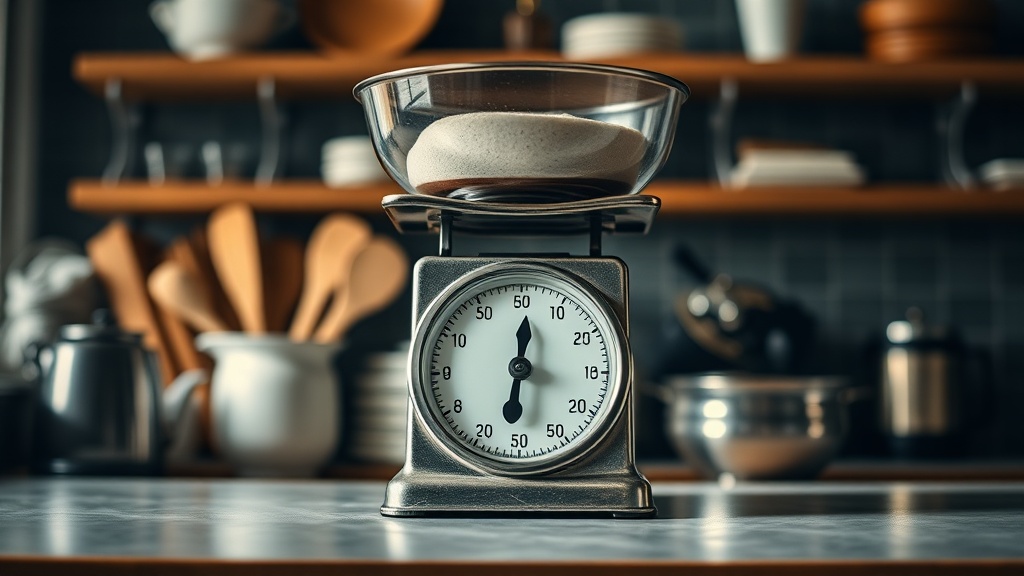
Why Your Kitchen Scale is the Most Important Tool for Consistency

Everything you need to know about weighing ingredients for perfect results
You'll learn why digital scales are more reliable than measuring spoons and how they change the way you approach both baking and coffee brewing. Precision isn't just for scientists; it's the difference between a recipe that works every time and one that leaves you guessing.
Most home cooks rely on volume. We grab a measuring cup, fill it with flour, and level it off with a knife. It seems fine—until you realize that a "cup" of flour can vary by as much as 20-30 grams depending on how tightly it was packed into the container. That tiny discrepancy is enough to turn a light, airy sponge cake into a dense, heavy brick. When you switch to a digital scale, you stop guessing and start knowing. You aren't measuring space; you're measuring mass.
This shift in perspective is particularly vital when you're working with high-quality coffee beans or specialty ingredients. If you're brewing a pour-over and you're only using a scoop, you're playing a game of chance. A single scoop of beans might weigh 15 grams one day and 18 grams the next. That inconsistency ruins the flavor profile you worked so hard to select. By using a scale, you ensure that the ratio of water to coffee is exactly what the recipe demands, every single time.
Is a digital scale better than measuring spoons?
The short answer is yes. To understand why, we have to look at how ingredients behave. Liquids like water or milk are relatively stable in volume, but solids like flour, sugar, cocoa powder, and even coffee grounds are incredibly temperamental. A tablespoon of salt is much more dangerous to miscalculate than a tablespoon of water. One heavy-handed pour can ruin an entire batch of dough.
Consider the way different ingredients interact with air. A spoon of cinnamon is fine, but a spoon of baking soda is a serious matter. If you use a scale, you're measuring the actual weight of the substance, which remains constant regardless of its density or how much air is trapped inside the container. This is why professional pastry chefs and serious coffee enthusiasts rarely, if ever, use volume-based measurements. They rely on grams. It’s a more stable, universal language for the kitchen.
If you want to see how weight impacts professional baking standards, you can check out the guidelines provided by the King Arthur Baking resources, which frequently emphasize the importance of weight over volume for consistent results.
Which type of scale should you buy for your kitchen?
Not all scales are created equal, and your choice depends on what you intend to do most often. For general cooking and baking, a standard kitchen scale that goes up to 5kg or 11lbs is usually plenty. However, if you're a coffee enthusiast, you'll want something much more specialized. A standard kitchen scale might only show increments of one gram, but for coffee, you need a scale that shows 0.1 grams.
- Standard Kitchen Scales: Best for flour, sugar, and large batches of dough. They are usually cheaper and can handle larger weights.
- Precision/Jewelry Scales: Best for small amounts of spices, salt, or coffee beans. These show much finer increments (0.1g or 0.01g).
- Coffee Scales: These often include a built-in timer, which is a huge advantage when you're timing your pour-over or AeroPress brew.
When shopping, look for a scale with a "tare" function. This is a non-negotiable feature. The tare function allows you to reset the scale to zero while an object (like a bowl or a coffee dripper) is still sitting on it. This way, you can weigh your ingredients directly in the vessel you'll be using, making your process cleaner and faster.
How do I use a scale to improve my coffee brewing?
If you've ever wondered why your coffee tastes different every morning, the culprit is likely your ratio. A standard starting point for many is the 1:16 ratio—one part coffee to sixteen parts water. Without a scale, you're just guessing at that ratio. If you use a scoop, you're assuming every scoop is identical. But beans come in different sizes, and even the way they settle in the bag can change the weight of a single scoop.
To use a scale for coffee, follow these steps:
- Place your empty carafe or dripper on the scale and turn it on.
- Press the "tare" button to zero it out.
- Add your coffee grounds until you hit your target weight (e.g., 20 grams).
- Press "tare" again to zero out the weight of the grounds.
- Start your timer and pour your water, watching the weight increase in real-time.
This method ensures that your extraction is consistent. If you're looking for more technical breakdowns of brewing ratios, the Perfect Daily Grind offers deep dives into the mathematics of coffee extraction and how weight affects the final cup.
Using a scale isn't just about being a "perfectionist." It's about developing a sense of intuition. When you know that 125 grams of flour looks a certain way, you'll eventually be able to eye-ball it more accurately in a pinch. But until then, the scale is your best friend in the pursuit of culinary excellence. It removes the guesswork and replaces it with data. Whether you're making a sourdough loaf or a delicate pour-over, the scale provides the foundation for success.
| Ingredient Type | Best Measurement Method | Reasoning |
|---|---|---|
| Flour/Dry Goods | Weight (Grams) | Density varies wildly with volume. |
| Water/Liquids | Weight (Grams) or Volume (ml) | 1g of water equals 1ml, making it easy. |
| Spices/Small Amounts | Precision Scale (0.1g) | Even a tiny error can ruin the dish. |
| Coffee Grounds | Precision Scale (0.1g) | Critical for consistent extraction ratios. |