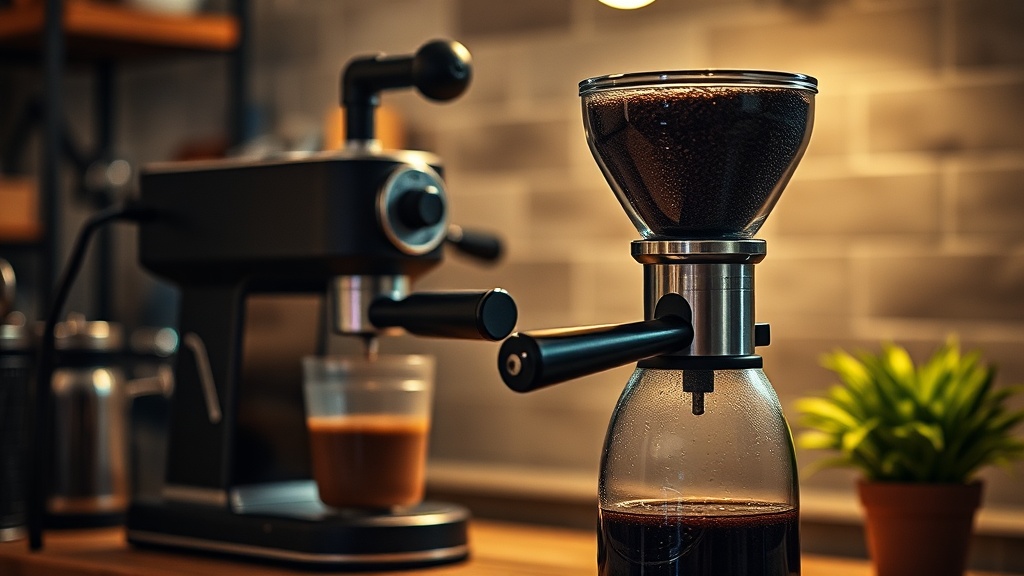
Everything You Should Know About Choosing the Right Coffee Grinder

You just bought a bag of light-roast Ethiopian beans that cost way too much to ruin. You set your kettle, your scale, and your V60, but when you pour the water, the coffee tastes bitter, sour, and uneven. The culprit isn't your technique or your water temperature—it's your grinder. This guide explains the mechanics of coffee grinding, the difference between burr and blade types, and how to choose a machine that actually matches your brewing-to-be.
The quality of your grind determines how much surface area is exposed to water. If the particles are inconsistent, your coffee will taste "muddy" or "sharp." You need to understand the gear before you drop hundreds of dollars on a machine that might not even suit your coffee maker.
What is the difference between a burr grinder and a blade grinder?
A burr grinder uses two revolving abrasive surfaces to crush beans into uniform particles, while a blade grinder uses spinning blades to chop them into uneven chunks. If you want high-quality coffee, you want a burr grinder.
Blade grinders—the kind you usually see in cheap $20 grocery store models—are essentially just spinning blades that smash the beans. They create a mix of "dust" and large chunks. This is why your pour-over might taste both bitter and sour at the same time. The dust over-extracts, and the big chunks under-extract.
Burr grinders, on the other hand, are much more precise. They provide a consistent particle size, which is vital for methods like brewing perfect pour-over coffee at home. You can find different types of burrs depending on your needs:
- Conical Burrs: These are shaped like a cone and are common in many home grinders like the Baratza Encore. They are great for most brewing methods.
- Flat Burrs: These consist of two flat plates stacked on top of each other. They often produce a more uniform particle size and are favored by many professional baristas.
- Ceramic vs. Steel: Ceramic burrs stay cool and are great for longevity, but steel burrs are generally sharper and more efficient at cutting through beans.
It's a matter of precision. If you're serious about your morning routine, don't settle for a blade grinder. It's simply not worth the frustration of inconsistent coffee.
How much does a good coffee grinder cost?
A decent entry-level burr grinder typically costs between $50 and $150, while high-end professional-grade equipment can exceed $1,000.
The price you pay usually reflects the build quality, the motor's strength, and the precision of the adjustment mechanism. I've seen people try to save money by buying a cheap blade grinder, but they end up spending more in the long run by buying better beans they can't actually enjoy. It's a bit of a cycle.
Here is a rough breakdown of what to expect at different price points:
| Price Range | Type of Grinder | Typical Use Case |
|---|---|---|
| $20 - $50 | Basic Blade or Manual | Casual users or travelers |
| $100 - $250 | Entry-Level Burr | Daily pour-over or Aeropress |
| $300 - $600 | Mid-Range Electric | Home baristas and espresso lovers |
| $700+ | High-End / Pro | Precision-focused espresso brewing |
If you're on a budget, look for manual hand grinders like the Timemore C3 or the 1Zpresso K-Ultra. They are often much better than electric grinders in the same price bracket because you aren't paying for a motor—you're paying purely for the burr quality. (Just be prepared to get a little arm workout in the morning.)
Which type of grinder do I need for my coffee method?
Your choice of grinder depends entirely on whether you are making espresso, drip coffee, or French press.
The "grind size" is the distance between the burrs. A smaller distance means a finer grind, and a larger distance means a coarser grind. If you use the wrong size for your method, the coffee will taste terrible.
Espresso: This requires a very fine, flour-like consistency. Because espresso involves high pressure, the grind must be incredibly precise. If your grinder can't go fine enough, your espresso will be watery and sour. Brands like Eureka or Mazzer are the gold standard here, though they are quite an investment.
Pour-Over & Drip: You're looking for a medium grind, similar to table salt. You need a grinder that can handle a wide range of settings so you can "dial in" your recipe. The Baratza Encore is a classic choice for this because it's easy to adjust and reliable.
French Press: This requires a coarse grind, looking more like sea salt. Since the coffee steeps in water for a long time, a coarse grind prevents the cup from becoming overly bitter. Most burr grinders can easily achieve this.
The catch? Many "all-in-one" grinders claim to do everything, but they often do nothing perfectly. An espresso-focused grinder might struggle to go coarse enough for a French press, and a cheap drip grinder won't be able to go fine enough for a real shot of espresso. Pick a direction and stick to it.
It's helpful to research the specific grind range of a product before buying. You can check Wikipedia's technical-style breakdowns of coffee-making equipment if you want to get into the nitty-gritty of particle distribution physics.
One thing to keep in mind: heat is the enemy. High-speed electric motors can actually heat up the burrs, which slightly toasts the coffee oils during the grinding process. This can lead to a "stale" taste. If you're a true enthusiast, look for grinders that prioritize low-RPM motors or manual options to keep things cool.
If you're just starting out, don't overthink it. Start with a decent manual burr grinder or a mid-range electric one. You'll see an immediate difference in your coffee's flavor profile. It's the single best investment you can make in your home coffee setup.